Microsoft
How Bill Gates turned a licensing deal into the most valuable software company in history
Gates didn't write the operating system that made Microsoft. He licensed it, renamed it, and sold it to IBM — then kept the rights. That single decision built a $3 trillion company.
The origin
Bill Gates and Paul Allen founded Microsoft in Albuquerque, New Mexico in April 1975. Gates was nineteen years old and had dropped out of Harvard. Allen was twenty-two. Their first product was a version of the BASIC programming language for the Altair 8800 — a hobbyist computer kit that had appeared on the cover of Popular Electronics and sold out immediately.
The Altair BASIC was not a business. It was a proof of concept: Gates and Allen could write software that ran on microcomputers, and there was a market of hobbyists willing to pay for it. Gates famously wrote an open letter to the Altair community in 1976 complaining that most users were copying the software rather than paying for it. The letter was widely mocked. It was also the first articulation of a principle that would define Microsoft's business model for the next fifty years: software has value, and the people who create it deserve to be paid.
Microsoft moved to Bellevue, Washington in 1979, closer to the emerging technology ecosystem of the Pacific Northwest. By 1980, the company had thirteen employees and revenues of about $2.5 million — respectable for a software startup, but not yet consequential.
Then IBM called.
The challenge
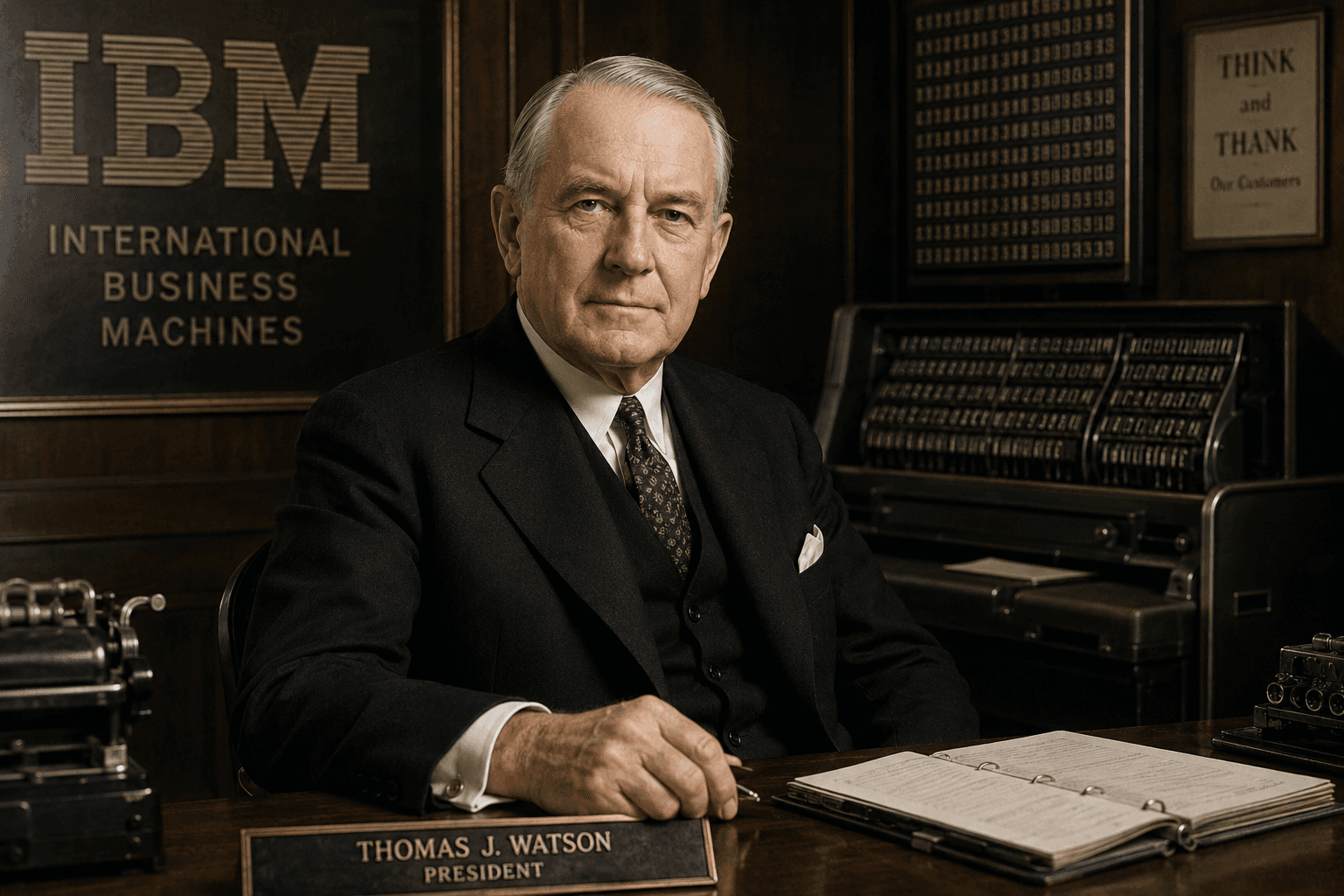
In 1980, IBM was building its first personal computer. The project was secret, fast-moving, and unlike anything IBM had done before. IBM's traditional approach — designing every component in-house, controlling every part of the system — was too slow for the PC market. The team in Boca Raton, Florida, decided to build the IBM PC from off-the-shelf components and license the operating system from an outside vendor.
IBM approached Digital Research, the company that made CP/M — the dominant operating system for microcomputers at the time. The meeting did not go well. Gary Kildall, Digital Research's founder, was reportedly flying his plane when IBM arrived, and the negotiations stalled over a non-disclosure agreement. IBM turned to Microsoft.
Gates did not have an operating system. But he knew where to find one. He paid $50,000 to acquire QDOS — Quick and Dirty Operating System — from a Seattle programmer named Tim Paterson, who had written it as a CP/M clone for a different hardware project. Microsoft renamed it MS-DOS, cleaned it up, and licensed it to IBM.
The critical detail — the one that made Microsoft — was in the contract. IBM paid Microsoft a flat fee for the license. Microsoft retained the right to license MS-DOS to other manufacturers.
Gates had understood something that IBM had not: the IBM PC's open architecture meant that other manufacturers would clone it. Every clone would need an operating system. Every clone that ran MS-DOS would pay Microsoft a royalty. IBM had licensed the operating system for its own machine. Microsoft had licensed the operating system for the entire PC industry.
The breakthrough
The IBM PC launched in August 1981 and was an immediate success. Within a year, Compaq had introduced the first IBM-compatible clone. Within three years, dozens of manufacturers were building IBM-compatible PCs. Every one of them ran MS-DOS.
By 1984, Microsoft had revenues of $97 million. By 1986, when the company went public, revenues were $197 million and Gates was worth $350 million at age thirty. By 1990, Microsoft had revenues of $1.18 billion and was the most profitable software company in the world.
The Windows operating system, introduced in 1985 and reaching commercial viability with Windows 3.0 in 1990, extended the platform logic. Windows was not technically superior to the Macintosh operating system — Apple's interface was widely considered more elegant. But Windows ran on any IBM-compatible hardware, which meant it ran on the cheapest machines available. As PC hardware prices fell through the 1990s, Windows became the operating system of the world.
Microsoft's Office suite — Word, Excel, PowerPoint — followed the same logic. Each application was available on both Windows and Macintosh, but the integration between Office applications worked best on Windows. The suite became the standard for business computing globally, and the standard created a switching cost that competitors could not overcome. Learning a new word processor meant retraining every employee. The cost of switching was higher than the cost of the license.
Gates understood switching costs the way Walton understood supply chains: as a structural advantage that compounded over time. Every business that standardized on Microsoft Office in 1995 was still running Microsoft Office in 2005, and in 2015, and in 2025.
The impact
Microsoft's market capitalization reached $1 trillion in 2019 — the third American company to do so, after Apple and Amazon. Under Satya Nadella, who became CEO in 2014, Microsoft pivoted from a software licensing company to a cloud services company. Azure, Microsoft's cloud platform, became the second-largest cloud provider in the world behind Amazon Web Services.
The pivot required Microsoft to abandon the licensing model that had made it dominant and embrace a subscription model — Office 365, Azure consumption pricing — that aligned the company's revenue with customers' actual usage. It was a difficult transition that required writing down billions in legacy revenue. It worked because Nadella understood that the platform logic Gates had applied to operating systems in 1981 applied equally to cloud infrastructure in 2014: own the platform, and the applications will follow.
Microsoft's acquisition of LinkedIn in 2016 for $26 billion and GitHub in 2018 for $7.5 billion extended the platform into professional networking and software development — two categories where network effects create the same switching costs that MS-DOS created in 1981.
The $69 billion acquisition of Activision Blizzard in 2023 extended the platform into gaming, where Microsoft's Xbox Game Pass subscription service was competing with Sony's PlayStation for the same platform logic: own the ecosystem where games are played, and game developers will follow.
The legacy
Gates stepped back from Microsoft's day-to-day operations in 2000 and from the board in 2020. His philanthropic work through the Bill & Melinda Gates Foundation — focused on global health, poverty reduction, and education — has become as consequential as his business career.
The Microsoft story is fundamentally a story about business model design. Gates did not win because he wrote better software than his competitors. He won because he understood that the value in the PC industry would accrue to whoever controlled the platform — the layer of software that everything else ran on — and he structured his IBM deal to capture that value.
For smaller businesses, the lesson is not about operating systems or cloud platforms. It is about the difference between selling a product and owning a platform. A product is sold once. A platform creates recurring value — and recurring revenue — every time someone uses it.
Gates didn't write the operating system that made Microsoft. He kept the rights to it. The business model was the strategy.
The question Gates answered in 1980 — who owns the rights when this relationship ends? — is the right question for any business entering a partnership, licensing agreement, or distribution deal. The answer determines whether you are building a business or building someone else's.